
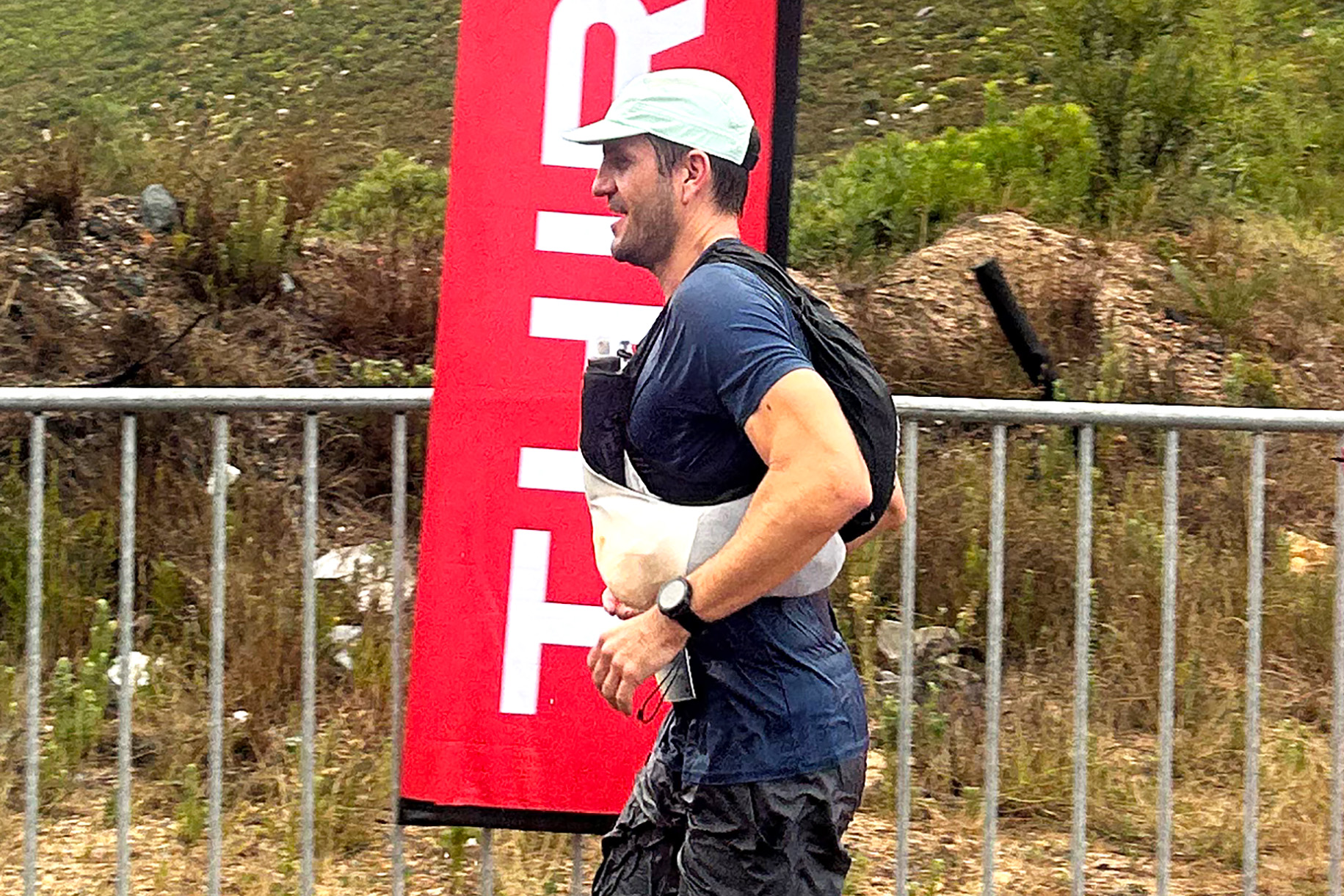

Under stress, our capacity to make deliberate, informed decisions decreases. What remains available to us in difficult moments is not creativity or willpower, but what we have already practiced. When fatigue, discomfort, or uncertainty peak, we default to established habits rather than inventing new responses.
In those moments, the decision you make will feel justified. It will make sense at the time. This does not mean it is optimal. It means it is familiar.
Quit resilience is not about forcing yourself to continue at all costs. It is about training responses that keep you engaged, adaptive, and capable of solving problems when conditions deteriorate.
On race day, discomfort is expected and problems will arise. These may be minor, such as stopping to remove a pebble from your shoe, or more significant, such as stomach distress that prevents you from keeping food down.
When races diverge from expectation, it is easy to interpret this as failure or assume the race is unraveling. More often, it is simply the race revealing itself. The task is not to resist this reality, but to respond to it.
Problem-solving under fatigue is part of the experience of trail running. Learning to stay engaged with challenges, rather than overwhelmed by them, is a skill that can be practiced.
In addition to the A.D.A.P.T. framework discussed previously, the following four psychological strategies can help you manage adversity and discomfort more effectively. These strategies are most useful when they are practiced regularly in training rather than deployed for the first time on race day.
Segmenting involves breaking a large or daunting task into smaller, manageable units. Rather than holding the entire race in mind, attention is directed toward the next immediate objective.
This is more difficult in high-pressure situations where outcomes feel important. Under stress, we revert to what we have practiced consistently, not what we wish we could do. For this reason, segmenting should be practiced regularly in training, even when you feel strong and comfortable.
In a race setting, segmenting may involve dividing the route into sections or setting short, process-based goals such as reaching the top of the next climb, running for two more minutes, or keeping a walk break to a defined duration. This approach reduces cognitive load, keeps attention anchored in the present, and makes forward progress feel achievable even when the overall task feels overwhelming.
Visualization is based on the principle that imagining an action activates neural patterns similar to those used during physical execution (Decety, 1996). Numerous studies have examined the relationship between mental imagery and athletic performance (Isaac, 1992; Richardson, 1967; Roure et al., 1998).
The research consistently shows that mental imagery alone does not outperform physical training. However, mental imagery combined with physical training produces better results than physical training in isolation.
Effective visualization involves accurately imagining yourself performing specific tasks within your race environment. This includes visual detail, physical sensations, and appropriate actions. Associating imagery with simple verbal cues that reflect feeling or form can improve execution. For example, imagining the sensation of floating can help maintain efficient running mechanics late in a race.
Visualization requires focus. Sessions with low concentration are unlikely to be effective. Fewer, high-quality imagery sessions are more valuable than frequent unfocused attempts. Developing this skill takes practice.
Examples of useful visualization scenarios include pushing through fatigue late in the race, navigating technical terrain smoothly, anticipating environmental conditions such as heat or altitude, and efficiently moving through aid stations while meeting nutritional needs.
Association and dissociation are two distinct cognitive strategies used during endurance exercise.
Association involves directing attention toward the task itself. This may include monitoring physical sensations, pacing, breathing, or nutrition. Dissociation involves directing attention away from the task, either internally through daydreaming or externally through scenery, music, or spectators.
Research in marathon runners has shown that internal association is commonly used, while internal dissociation has been linked to hitting the wall or bonking (Stevinson & Biddle, 1998). Reduced awareness of bodily feedback can contribute to pacing errors and delayed fueling.
Other studies have shown that associative strategies are linked to improved running performance (Saintsing et al., 1988). A long-term review found that association tends to relate to faster performance, while external dissociation may reduce perceived exertion and support endurance under certain conditions (Masters & Ogles, 1998).
More recent work suggests that both strategies have value depending on exercise intensity (Lind et al., 2009). Dissociative strategies may be useful at low to moderate intensities, while associative strategies become more effective as intensity increases and physiological cues dominate.
In practice, this means paying close attention to effort, pacing, and fueling when the race becomes demanding, and allowing attention to broaden outward when conditions are stable and manageable. Skilled endurance athletes move fluidly between these strategies rather than rigidly adhering to one.
Self-talk is a well-supported mental training tool that can meaningfully influence performance (Basset et al., 2021; Hamilton et al., 2007; Hardy et al., 2019; Weinberg et al., 2012). The content and structure of self-talk matter.
Research shows that self-talk can alter hormonal responses, cardiorespiratory function, and perceived exertion in both positive and negative directions depending on its quality (Basset et al., 2021).
Two primary forms of positive self-talk are commonly discussed.
Motivational self-talk focuses on encouragement and persistence. Phrases such as “You can do this” or “Stay with it” are often repeated rhythmically. Research suggests this type of self-talk is most effective when delivered in the second person rather than the first (Hardy et al., 2019). Motivational self-talk is often strengthened by connection to personal values or reasons for participating.
Instructional self-talk focuses on specific actions. Examples include cues such as relaxing the shoulders, maintaining cadence, or controlling breathing. This type of self-talk directs attention toward execution and can improve task performance under fatigue.
Both forms of self-talk tend to promote an associative attentional state, which aligns with research linking association to improved endurance performance.
Experimentation is important. Different athletes respond differently to different cues. Training is the appropriate environment to test strategies and identify what is most effective for you.
These psychological strategies are not emergency tools. They are skills that improve through repeated exposure and deliberate practice. Training sessions and races provide regular opportunities to practice responding to discomfort, uncertainty, and stress in a controlled way.
Over time, resilience becomes less about enduring suffering and more about staying engaged, flexible, and responsive when conditions change.
Basset, F.A. et al. (2021) ‘Type of self‐talk matters: Its effects on perceived exertion, cardiorespiratory, and cortisol responses during an iso‐metabolic endurance exercise’, Psychophysiology, 59(3). doi:10.1111/psyp.13980.
Decety, J. (1996) ‘Do imagined and executed actions share the same neural substrate?’, Cognitive Brain Research, 3(2), pp. 87–93. doi:10.1016/0926-6410(95)00033-x.
Hamilton, R.A., Scott, D. and MacDougall, M.P. (2007) ‘Assessing the effectiveness of self-talk interventions on endurance performance’, Journal of Applied Sport Psychology, 19(2), pp. 226–239. doi:10.1080/10413200701230613.
Hardy, J., Thomas, A.V. and Blanchfield, A.W. (2019) ‘To me, to you: How you say things matters for endurance performance’, Journal of Sports Sciences, 37(18), pp. 2122–2130. doi:10.1080/02640414.2019.1622240.
Isaac, A.R. (1992) ‘Mental practice — does it work in the field?’, The Sport Psychologist, 6(2), pp. 192–198. doi:10.1123/tsp.6.2.192.
Laasch, C. (1995) ‘Cognitive strategies and long-distance running’, Imagination, Cognition and Personality, 14(4), pp. 317–332. doi:10.2190/ukg1-7w12-66a5-7aq7.
Lind, E., Welch, A.S. and Ekkekakis, P. (2009) ‘Do “mind over muscle” strategies work?’, Sports Medicine, 39(9), pp. 743–764. doi:10.2165/11315120-000000000-00000.
Masters, K.S. and Ogles, B.M. (1998) ‘Associative and dissociative cognitive strategies in exercise and running: 20 years later, what do we know?’, The Sport Psychologist, 12(3), pp. 253–270. doi:10.1123/tsp.12.3.253.
Richardson, A. (1967) ‘Mental practice: A review and discussion part I’, Research Quarterly. American Association for Health, Physical Education and Recreation, 38(1), pp. 95–107. doi:10.1080/10671188.1967.10614808.
Roure, R. et al. (1998) ‘Autonomic nervous system responses correlate with mental rehearsal in volleyball training’, European Journal of Applied Physiology, 78(2), pp. 99–108. doi:10.1007/s004210050393.
Saintsing, D.E., Richman, C.L. and Bergey, D.B. (1988) ‘Effects of three cognitive strategies on long-distance running’, Bulletin of the Psychonomic Society, 26(1), pp. 34–36. doi:10.3758/bf03334853.
Stevinson, C.D. and Biddle, S.J. (1998) ‘Cognitive orientations in marathon running and “Hitting the wall”’, British Journal of Sports Medicine, 32(3), pp. 229–234. doi:10.1136/bjsm.32.3.229.
Weinberg, R., Miller, A. and Horn, T. (2012) ‘The influence of a self-talk intervention on collegiate cross-country runners’, International Journal of Sport and Exercise Psychology, 10(2), pp. 123–134. doi:10.1080/1612197x.2012.645135.
